

Risk-Reward Ratio Explained with Examples
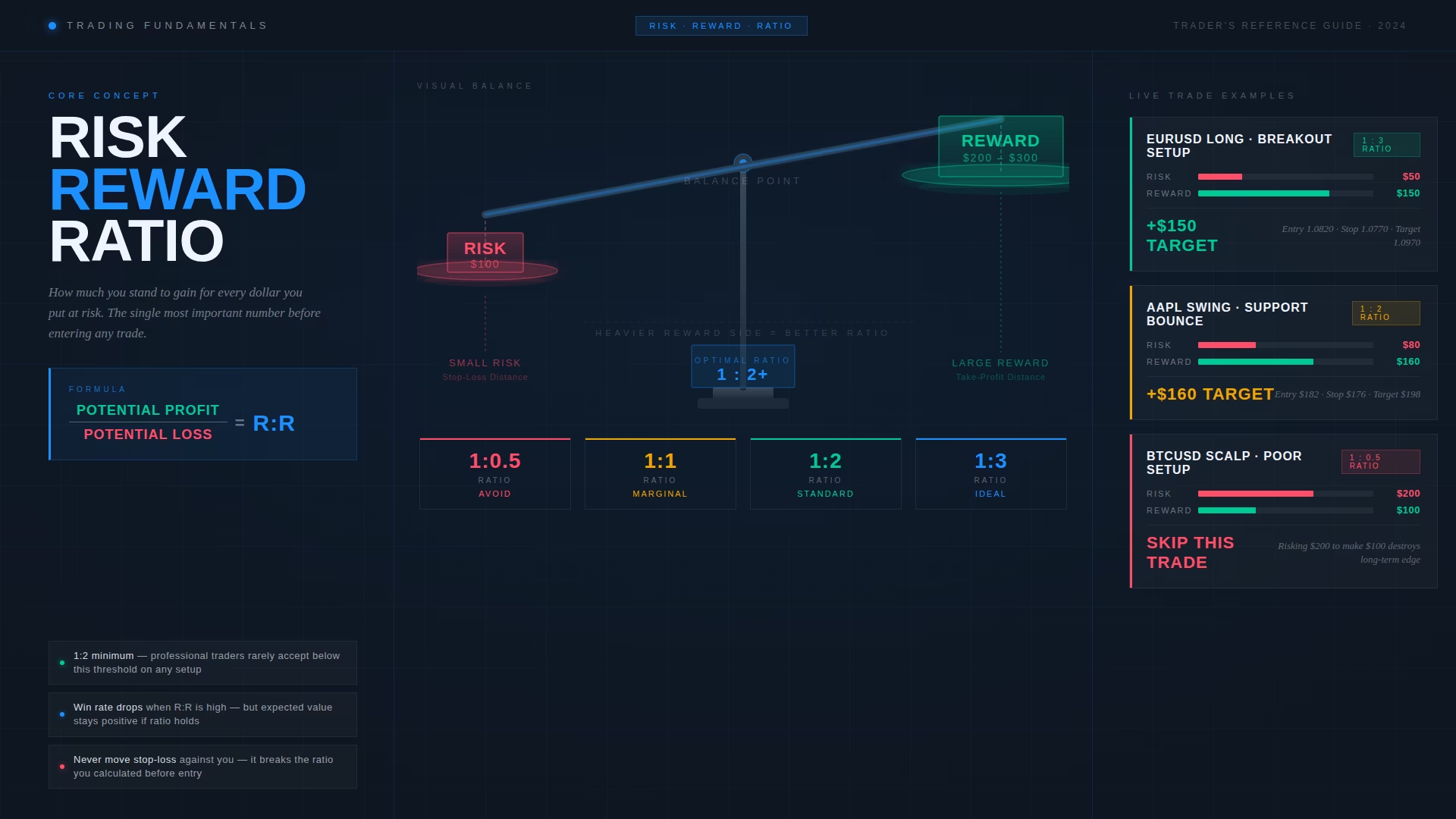
Ask ten traders what separates a profitable strategy from a losing one, and most will talk about win rate, that is, how often they’re right. But win rate alone tells you very little. A trader who wins 70% of the time can still lose money, and a trader who wins only 40% of the time can still be highly profitable. The missing piece is the risk-reward ratio. At ICunity, we treat this ratio as one of the first things every trader should understand, because it shapes almost every decision you make before you enter a trade.
Are you ready to transform your financial future?
Sign Up TodayNo credit card required • Free demo account • Instant activation
What Is the Risk-Reward Ratio?
The risk-reward ratio compares how much you stand to lose on a trade against how much you stand to gain if it works out. It is usually written as risk:reward, for example 1:2 or 1:3. A 1:3 ratio means that for every $1 you risk, you are targeting $3 in potential profit.
The formula is straightforward:
Risk-Reward Ratio = Potential Loss ÷ Potential Profit
You calculate potential loss using your entry price and stop-loss level, and potential profit using your entry price and target level.
Worked Examples
- Example 1 — 1:1 ratio: You buy a stock at $50, set a stop-loss at $45, and a target at $55. Risk = $5, reward = $5. Risk-reward ratio = 1:1.
- Example 2 — 1:2 ratio: You buy at $50, stop-loss at $45, target at $60. Risk = $5, reward = $10. Risk-reward ratio = 1:2.
- Example 3 — 1:3 ratio: You buy at $50, stop-loss at $48, target at $56. Risk = $2, reward = $6. Risk-reward ratio = 1:3.
- Example 4 — Forex trade: You go long EUR/USD at 1.0850, stop-loss at 1.0800 (50 pips risk), target at 1.0950 (100 pips reward). Risk-reward ratio = 1:2.
Why the Ratio Matters More Than Win Rate Alone
A favorable risk-reward ratio gives you room to be wrong. With a 1:3 ratio, you can lose three trades in a row, win the fourth, and still come out ahead. This is why professional traders often build their whole risk management framework around ratios like this rather than chasing a high win rate alone.
How to Set Realistic Risk-Reward Levels
- Decide your stop-loss first, based on where the trade idea is actually invalidated, not on a round number.
- Set your target based on real support/resistance levels, not wishful thinking.
- Avoid forcing a 1:3 ratio onto a setup that doesn’t support it. A realistic 1:1.5 beats an unrealistic 1:5.
- Combine your risk-reward ratio with a fixed risk-per-trade rule, for example never risking more than 1-2% of your account. This connects directly to good capital protection habits.
Common Mistakes Traders Make
- Moving the stop-loss further away mid-trade to “give it more room,” which quietly changes the ratio after the fact.
- Chasing very high ratios (1:5 or more) on setups where the target is unrealistic, leading to trades that rarely hit target.
- Ignoring how fear and greed affect trading decisions, since these emotions are usually what cause traders to abandon a good ratio mid-trade.
- Focusing only on the ratio and ignoring win rate entirely; the two only work together.
Risk-Reward Ratio and Long-Term Consistency
A single good ratio on one trade means very little. What builds a career is applying a consistent minimum ratio across hundreds of trades, paired with genuine trading consistency. For a deeper look at how the ratio is used across different markets, Babypips’ guide to the risk-reward ratio is a solid additional reference.
Key Takeaways
- Risk-reward ratio compares potential loss to potential profit on a trade, written as risk:reward.
- A 1:2 or 1:3 ratio means you can be wrong more often than you’re right and still be profitable.
- Set your stop-loss and target based on the chart, not on a ratio you want to see.
- Pair your risk-reward ratio with a fixed risk-per-trade rule for real capital protection.
- Consistency across many trades matters more than any single well-timed trade.
Trade With Structure, Not Guesswork
Understanding your risk-reward ratio is one part of a bigger picture that includes discipline, regulation, and transparency. You can review how ICunity approaches licensing and client protections on our Regulatory page, and explore more educational content at ICunity.